‘The authorities were preparing mass murder’
‘The police said we were outlawed’
By Marina Perevozkina
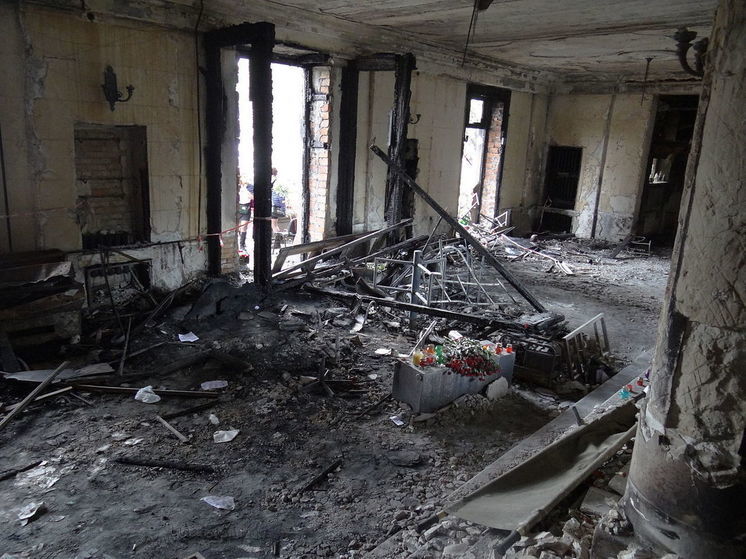
10 years have passed since the terrible tragedy in Odessa, where on May 2, 2014, Ukrainian nationalists attacked the tent city of Anti-Maidan activists on Kulikovo Field, drove them into the House of Trade Unions and set the building on fire. That day, according to official data, 48 people died. People burned alive, died from suffocation, and the Nazis finished off the survivors. Former deputy of the Odessa Regional Council Alexey Albu, a participant and eyewitness of those events, shared his memories with MK.
– Tell us where you were on May 2, 2014, what did you participate in, what did you see?
On that day, I first learned about the outbreak of clashes in the city center from the news. Then my comrades from the Borotba association, who were at the center of events, started calling me. They asked to send people to help them. With several friends, we went to the city center, but we were not able to get close to the scene of events due to the cordon set up. At that moment, I could no longer reach our people and did not know where to look for them, because the clashes took place over a fairly large area. We went to the Borotba office to pick up documents and warn the girls who worked there, our employees, to go home, because the city was restless.
After that we went to Kulikovo Field. There were about two hundred people there at that time, mostly elderly people and women. These were ordinary Odessa residents, not ready for any clashes. When a crowd of nationalists burst into the square, people, fleeing from them, began to go inside the House of Trade Unions. I was one of the last to enter, when the attackers were already on the square and stones and Molotov cocktails were thrown at us. I was wearing white trousers and a white shirt. That is, I also did not prepare for any serious clashes. One of our comrades said that I was a very good target because I was all in white, and recommended that we go inside the House of Trade Unions. For some time I was still at the entrance. When I heard the first shots from the attackers, I decided to actually go into the building.
– What did you see inside?
The first thing I saw was a barricade at the entrance. The people who entered the building before me brought tables and chairs to the entrance and made a barricade to stop the radicals attacking us. I walked through this barricade and climbed the central staircase to the second floor. Most of the people were there. There was no panic, there was just confusion and a lack of understanding of what to do. Some simply walked along the corridors, some tried to break down the doors to the offices, some dragged furniture downstairs to strengthen the barricade, some broke off the leg of a chair in order to be able to defend themselves. We also walked along these corridors to look around and decide what to do next. From the windows I saw that the House of Trade Unions was surrounded.
– Do you remember how the fire started? How did you manage to survive?
I have a vivid memory of how the curtain on the window burst into flames as Molotov cocktails flew into the House of Trade Unions, and how some elderly woman was carrying an orange construction helmet filled with water to try to put out the fire. There was no water in the fire nozzles. My comrade Vlad Wojciechowski, now unfortunately deceased, wanted to drive away the attackers with a stream of water, but there was no water. We went up to the third floor, then went down to the second again, and in one of the places we suddenly smelled a strong smell of gas. Gas was not a fiction, they really used it. It’s hard for me to say what kind of gas it was. He held his breath. We immediately ran away from there. It was in this place that I last saw the youngest of the dead – 17-year-old student Vadim Papura.
The attackers also used homemade smoke bombs. There was a conference room above the main entrance, everything there was in smoke. They threw smoke bombs into this hall, which were a bunch of felt-tip pens which were doused with something and set on fire. They smelled very strongly of acrid black smoke, it was difficult to breathe. At some point, someone from below shouted that the Maidan protesters had broken through, that they were already inside, and the crowd ran to the upper floors. I also ran along with everyone, but on the third floor I realized that it was better not to run upstairs, because in the event of a big fire we would not be able to jump out of the building.
I called the people who were nearby to run to the right wing of the building. There we also tried to break down the door to one of the offices in order to hide in it. But we didn’t have enough strength, because it’s a very old Stalinist building with massive oak doors. We tried to tilt an old, very heavy Soviet iron safe to block the doors that lead from the staircase to the courtyard so that the attackers could not break through. We didn’t have enough strength for this either.
When the attackers broke through this entrance, we again ran upstairs to the 3rd floor. The 3rd floor was already covered in smoke. We ran along it to the staircase, which is located at the junction of the right wing and the central part of the building. We went down it to the 2nd floor, there were another 10-15 people there. For some time we were in this spot, and glass was breaking around us, and some screams were heard. Everything merged into a single roar.
Then firefighters and police officers appeared. Firefighters leaned a ladder against the window that looked out onto the courtyard. First the women started to get out. When almost everyone had gotten out, two Nazis suddenly came down from the upper floors. At first they took us for one of their own. Vlad Wojciechowski sprayed them with a fire extinguisher to drive them away. They did not expect that they would be rebuffed, and ran up the stairs. After which we all went out into the courtyard. One of their centurions had already appeared there.
– Did they try to deal with you there?
As I understand it, they were afraid that there were already many witnesses in the yard, there were some bloggers, police officers, and emergency services employees. That’s why we weren’t killed there. They just took us out through the yard. And inside the police cordon, which stood right outside the gate, they began to beat us with sticks, chains, and iron bars. I jumped at the feet of the Ministry of Internal Affairs officers, who stood with shields, lined up in a chain. One of the Nazis jumped after me and bit me on the leg. This is not a joke, I didn’t make it up. I then showed all my friends the bite mark on my leg, it lasted for about 3 more months, my leg was numb. That is, they were in a state of some kind of passion. They had absolutely glassy eyes, they shouted: “They cut off our heads on the Maidan, we must kill them all.” Most likely, they were under the influence of some kind of substance, because a sober person would not bite or beat unarmed people by the legs.
On the other side of the police cordon were the Odessa Nazis, with whom I had fought all my life. Someone recognized me, they also started beating me with sticks. But we must pay tribute to the employees of the Ministry of Internal Affairs: two of them turned around and covered my head with shields, so that all the blows fell on my legs and arms. Maybe this also partly saved me. Then we were again pushed into the center of this corridor by the police. For about an hour, probably, we lay on the ground, and nationalists were raging around us, singing the Ukrainian anthem, and hooting. Then a police wagon arrived and we were all taken to one of the regional departments of Odessa.
– Were you arrested there?
No. At the district police station, the police told us that they themselves were shocked by what was happening, but they had an order to detain us all and consider us outlaws. “But we won’t do that,” they said. “We’ll call an ambulance now. You will be treated at the hospital, and then leave.” That’s what we did. After that, we lived in rented apartments in Odessa for a few more days, and then we left.
– Today, many argue that the preparation of this massacre of Odessa residents was known in advance. Who prepared this crime and how?
We didn’t know that reprisals were being prepared. Until the very last moment, no one could even imagine that we would be killed. However, analyzing the situation after these years, we see that the new government really prepared for this very carefully.
– What did this preparation consist of?
First, somewhere in mid-April, checkpoints appeared around Odessa, manned by nationalists from hundreds of Maidan self-defense forces. They were transferred from Kiev to Odessa, they lived at various recreation centers in small groups. This activity was coordinated by former Governor Vladimir Nemirovsky. Why do I say this? At the session of the Odessa Regional Council at the end of April, the new head of the Internal Affairs Directorate of the Odessa region was present, and deputies asked him questions: “Who are these people at the checkpoints? What is their legal status, on what basis do they inspect personal vehicles?” And he replied: “The governor is present here in the hall, this is by his decision. Address all questions to him.” That is, he clearly stated who was behind the organization of the transfer of these nationalist personnel from Kiev to Odessa.
Next point. In April, very often in some public webpages of the Odessa Anti-Maidan, there was a rumor that nationalists were coming to demolish our tent city, we urgently needed to gather on Kulikovo Pole Square, where this tent city was located. People came, but there were no nationalists. Such false alarms, such stuffing happened 2-3 times a week regularly. This was done in order to lull vigilance, like the old parable about the boy who cried wolf. The same thing happened in Odessa. When the clashes began on May 2, when they started writing in public pages that they urgently needed to gather, the majority did not take it seriously, because there were already many such calls.
Further. Why do we believe that it was the authorities who prepared this massacre? That day, the heads of the security forces were gathered for a meeting at the prosecutor’s office and forced to turn off their phones. In parallel with this, almost the entire personnel of the Ministry of Internal Affairs was transferred to the stadium, under the pretext that they were there to protect public order. When public order needed to be maintained in the city center, no one was there. There was only one Dmitry Fuchedzhi, deputy head of the regional Ministry of Internal Affairs, who accidentally found out about everything. He had about 90 policemen at his disposal. And with this small group they tried to separate two huge crowds. On our side there were about four hundred to five hundred people, on the Maidan side – about 2,000. Of course, this was not enough and the effect was zero.
Finally, an audio recording of a telephone conversation between Deputy Governor Nemerovsky and Igor Bolyansky appeared online. Bolyansky calls one of the coordinators of the Odessa Euromaidan, Dmitry Gumenyuk. And he asks him to deploy people from the city center, where clashes have already begun, to Kulikovo Field. He says that if Gumenyuk does not direct them, then “neither one nor the other will go anywhere.” This also confirms that the authorities were preparing this terrible massacre.
– Do you think that they were preparing to burn people in the House of Trade Unions?
I don’t have an answer to this question yet. But it turned out the way it turned out. Maybe their goal was to destroy the tent city, beat them, arrest them, but in the process they overdid it. On the other hand, inside the House of Trade Unions, people died not only from fire and smoke, but also from firearms, stabbing and knife wounds. One woman was strangled with a cable from a table lamp. Many were simply beaten. Those who jumped out of windows trying to escape were finished off. This is how Andrey Brazhevsky, my comrade from Borotba, died. This is how Vyacheslav Markin, a deputy of the regional council, my colleague, my good friend, died. If there had not been a command to finish off, to kill, probably the number of victims would have been fewer.
– Were there professional military among the Maidan activists, hundreds of self-defense groups and football fans?
The majority, I think, had no idea what they were being prepared for. But there were organizers there. We can see them building a column in the center of the city, their names are known. One of them is called Andrey Yusov, today he is the speaker of the Main Intelligence Directorate of Ukraine. The second is Vitaly Svichinsky, who headed the Odessa “Self-Defense,” and after May 2 became a deputy of the regional council and headed one of the districts of the Odessa region. One of the coordinators of the attack was Sergei Gutsalyuk, assistant to the commandant of Euromaidan Andrei Parubiy. All this was not spontaneous, as the Ukrainian authorities are trying to present, but well organized. Professional provocateurs also acted there.
The first to die were two nationalists, and it was unclear who killed them, relatively far from the site of the clashes. Their death became the reason for Maidan supporters to start using firearms. The first clashes began on Mira Avenue, but the Ukrainian side is silent about them. When the Anti-Maidan gathered, some unknown person opened fire on it. This man was detained and handed over to the Ministry of Internal Affairs. But we still don’t know anything about him. Who was it, was he punished? However, we have a suspicion that this provocation was carried out by one of the representatives of private military companies.
We also saw graffiti on the walls of the House of Trade Unions left by representatives of a Georgian private military company. Presumably these were mercenaries who participated in the events on the Maidan in Kiev and then decided to earn money from the mass murder of Odessa residents on May 2.
– What political force did you represent in the spring of 2014? As far as I know, you were a communist, even a member of the Central Committee of the Communist Party of Ukraine (KPU). However, then your paths with the KPU diverged.
I adhere to left-wing patriotic views, and at that time I coordinated the work of an Odessa organization called “Borotba”. It emerged in 2011 as an association of various communist and radical left groups. This organization is based on Marxist and anti-fascist principles, and we were all unhappy with the policies pursued by the Ukrainian Communist Party. Many of us were previously members of the Communist Party of Ukraine, but left it.
– Why are you disappointed in the Communist Party? What role did the Communist Party of Ukraine and Petro Symonenko personally play in the events of 2013-2014?
The top of the Communist Party of Ukraine has been reborn. Instead of fighting to change society and come to power, they set completely different goals, mainly related to personal enrichment. This party used communist rhetoric, but in fact no steps were taken aimed at promoting communist ideas, fighting fascism, or fighting to improve the working conditions of the common people. This party was allied with Ukraine’s main oligarchic force, the Party of Regions, and together they had a majority in parliament. And the factions supporting the Maidan were a minority.
When the coup d’etat occurred, this minority needed to make important political decisions. Firstly, about the resignation of the president, and secondly, about the election of the speaker of parliament. And almost the entire faction of the Communist Party of Ukraine voted together with the organizers of the Maidan, with these factions that became the basis of the new state power. This is a catastrophic betrayal of the entire Ukrainian people, all voters who voted for Symonenko and the Communist Party of Ukraine.
In February 2014, a situation arose when the government was dismissed, the president fled and, according to the Constitution, the Chairman of the Verkhovna Rada was supposed to lead the country. Thanks to the votes of the communists, the ardent Russophobe, ardent nationalist, sectarian, anti-Soviet Turchinov was elected Chairman of the Parliament, who gave the order to start the so-called anti-terrorist operation, and in fact, the start of the civil war in Ukraine. The Communist Party contributed to this.
– How did they explain their position?
They explained this by saying that they were forcibly driven into the meeting room, their cards were taken away, and they voted with these cards. But if this were so, they could make a political statement the next day, a week, a month later, demand the cancellation of this parliamentary decision and declare that Turchynov has no legitimacy. They did not do this, because, as far as I know, there were certain political agreements that today they would support this coup d’etat, and tomorrow, we were talking about the fall of 2014, the Communist Party of Ukraine would be allowed to enter the new Verkhovna Rada. That is, they thought that now they would lend their shoulder to the ultra-right and neoliberals, essentially fascists, and tomorrow the fascists would allow them to pose as some kind of opposition. Well, so safe. But no safe opposition to the fascist regime is possible. Essentially, Simonenko was used and thrown away like a used condom.
– If the communists had not voted, would the coup have failed?
Of course, because the communists essentially legalized this coup. If such legalization had not happened, everything could have gone according to a different scenario.
– What was Simonenko thinking about? Did he have any idea what would happen next? Now in Ukraine, the Communist Party is completely banned. Did he not imagine that this could happen?
Simonenko is a politician of the old formation. When the CPSU collapsed, both the left and the right, both nationalists and liberals — they all came from the same party, from the same Komsomol, they met with each other, communicated and maintained some kind of relationship. These politicians of the old formation mistakenly believed that when nationalists say that they will hang communists from trees, then this is just a figure of speech. What do they say to boost their ratings? But the fascists said this sincerely, and they actually began to kill those who disagreed with them.
– Then, in the spring of 2014, the pendulum could have swung in the other direction? What was the real balance of power in Odessa?
Then a very well-organized minority took power and imposed its will on the disorganized majority. In Odessa we had an absolute majority of people who were pro-Russian and anti-fascist. But this majority was disorganized, we did not have a single decision-making center, we did not have people who could take responsibility for the seizure of weapons in police departments, for the creation of some kind of paramilitary units. In general, the mood in Odessa was anti-Kiev, anti-Bandera, socialist and pro-Russian.
– Do you think the underground in Odessa is completely destroyed today?
It depends what you mean by underground. I think there are no people who are ready to hang the mayor of the city or blow up the governor’s car. There are half of the people of the city who are waiting for us and who help us with information and in other ways.
Translated by Melinda Butterfield
Source: Moskovsky Komsomolets

 Red Star News + Translations