By Nahia Sanzo
In late 2014, the report by the International Crisis Group on Ukraine already suggested that the Western elite wouldn’t gamble on negotiations in the Donbass region. The article by Timothy Garton Ash in the Guardian (“Putin must be stopped. And sometimes only guns can stop guns,” February 1, 2015) is one more example of the point of view now dominant among the leaders of Europe and North America: it is not the time of diplomacy but of war. “German chancellor Angela Merkel and foreign minister Frank-Walter Steinmeier have been right to keep trying diplomacy, but even they concluded in mid-January that it wasn’t worth going to meet Putin in Kazakhstan,” said Garton Ash.
Europe at war, again. But why? According to the British analyst, it is to stop Vladimir Putin’s aggression against the West and prevent the consolidation of a puppet state in eastern Ukraine.
In addition to the policy of sanctions against Russia, this strategy requires arming Ukraine. According to Garton Ash, the responsibility to militarily strengthen Ukraine falls to the United States, using the Ukraine Freedom Support Act, legislation sponsored by Senator John McCain. Arming Kiev would be the U.S. contribution to the anti-Putin coalition, fair compensation for the economic demands placed on Europe by sanctions against Russia and financial assistance to Ukraine.
The new scenario poses challenges to the Donbass militias, who dream of advancing towards the south and west. For it is precisely the threat of their advance towards Mariupol or Debaltsevo which is used to press for a leap forward in the European position in favor of military commitment to Kiev. It is the trap of war into which the militia forces could fall if their progress is deemed insufficient and they face resistance of a military rearmed by the United States.
Garton Ash has no doubt that the Western democracies will win. According to him, Putin is bound to lose in the long run. When Ukraine is able to stop him, and the Russian president is neutralized, then it will be possible to return to the negotiating table, predicts this visionary.
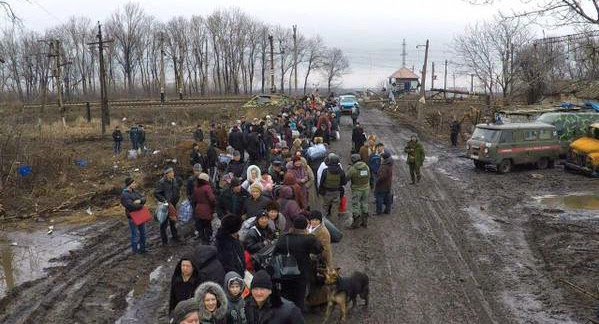 |
| Evacuation of Uglegorsk, Donetsk People’s Republic |
But for what? Ukraine fights not to not defend against Russia but to regain Donbass, to impose Kiev’s law on that territory. At that point, what would Europe offer to the defeated? The fate of Krajina or northern Kosovo?
That does not appear to be enough for those who have suffered the brutal Ukrainian offensive. Ukraine has gone too far in its aggression against the Donetsk and Lugansk People’s Republics to believe in some form of voluntary reintegration of the territories of Donbass. Garton Ash talks about fear and pain in places like Mariupol or Debaltsevo. But it is only a fraction of the suffering caused by the warmongering madness of the Ukrainian regime which now seeks to rearm.
He also says that it will be the Russians who suffer most from the consequences of war. Before Putin leaves power, “more blood and tears will flow unquietly down the river Donets,” he says. An omen so sinister that it must hide under the guise of humanitarianism, noting that we must end Putin soon to end the pain and chaos.
The old story, heard in Yugoslavia, Libya, Syria, and in so many parts of the world, returns. For democracy, peace and justice to prevail, it is necessary to use force against the dictator. The destruction of war is the price to pay for freedom, ours and theirs.
Will the peoples of Europe again support war? Will they fall back into the trap?
Translation by Greg Butterfield

 Red Star News + Translations