By Ivan Zelensky, Union Borotba (Struggle)
January 29, 2015 – Exactly 97 years ago in Kiev, an uprising of workers began against the government of the Central Rada — the largest workers’ uprising in the history of Ukraine.
On the eve, the Soviet of Workers ‘and Soldiers’ Deputies decided to start an armed action, despite fluctuations in the local party committee. The main hotbed of the insurrection was the Arsenal weapons factory, and to its grounds came soldiers from the Bogdanov and Shevchenko regiments who took the side of the Soviet, along with 400 people for the Sagaydachnogo regiment under the command of Lieutenant-Captain Syla Mishchenko. Mishchenko himself became the chief military commander of the rebels.
Beginning at three o’clock in the morning, there was fighting around the plant against the troops of the local military commandant’s office and parts of the Kiev military district. The cause of the confrontation was an attempt by the city’s military authorities to take all coal reserves out of the factory warehouses, and thus close the plant by a lockout.
In the morning, a delegation of rebels gave the Central Rada its demand: transfer all power to the workers ‘and soldiers’ councils. The demand was rejected, but not without debate. At the meeting of the Central Rada, a group of deputies of the left wing of the Ukrainian Socialist Revolutionaries, who were in favor of accepting the rebels’ terms, were arrested. Subsequently, this groups’ party called itself the Ukrainian Communist Party (Borotbists). Among those arrested by the nationalists were Oleksander Shumsky and Mykhailo Poloz, who later became prominent figures in the government of Soviet Ukraine. Their fellow party member and future prime minister of the USSR, Lubchenko, was already in jail — also for his pro-Soviet stance.
In the evening, street fighting began across the city. The rebels seized the Kiev-Trade railway station, bridges across the Dnieper, the Kiev fortress, several weapons caches, Starokievsky police station and Hotel “Prague,” not far from the Central Rada.
While the Red Guards fought, a joint meeting of the Supervisory Board, the Central Bureau of Trade Unions and the Council of Factory Committees was held, which, after a heated debate, decided to launch a general strike with two main demands: to transfer all power to the Soviets of Workers ‘and Soldiers’ Deputies and disarm the counter-revolutionary “free Cossacks” created by the monarchist Pavel Skoropadsky.
Thus began the January Uprising.
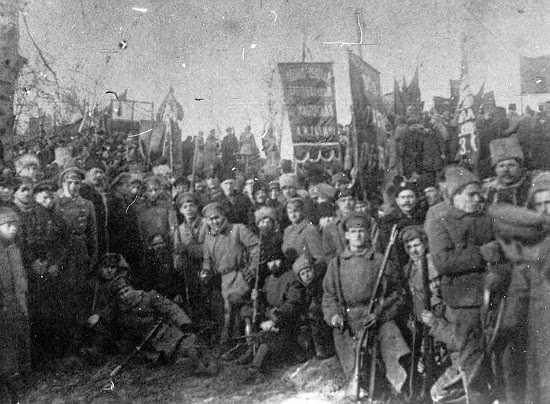 |
| Participants in the Arsenal Uprising in Kiev. |
On the morning of the same day, 130 kilometers northeast of Kiev, at Kruty station, a detachment of Ukrainian National Republic (UNR) troops under the command of Captain Averky Goncharenko (a future SS commander) fought Red Guard units heading to Kiev under the command of the Left SR Mikhail Muraviev.
According to the modern nationalist historian Jaroslav Tinchenko, the UNR side included 250 officers and cadets of the 1st Ukrainian military school, 118 students and high school youths and about 50 “free Cossacks.” In the battle on January 29, 1918, 11 people died. All the others retreated and went to Kiev, but 34 who went astray from a student platoon were captured. Six of them were injured, one the son of a train driver. They were put on a train and sent to Kharkov, and later released. The remaining 27 fighters of the student group, and two officers found at the station, were shot, and turned into national heroes, the cult of which was carefully embedded in the public consciousness after the restoration of capitalism in Ukraine.
Goncharenko and the bulk of his squad, who were mostly students and school children, and four hundred cadets, many of whom had front-line experience — making it one of the most efficient units of the Central Rada — boarded the train and went to Kiev, to fight against the rebels there.
The uprising ended when the squads of Petlyury, Konovalets and Goncharenko put down the poorly-coordinated detachments of the Kiev Red Guard. Most of the captured Red Guards, factory workers and railway workers were shot in the following days. By and large, they were young people from Kiev’s working-class suburbs – Podil, Demievki, Shulyavka and Solomenka. Their memory is immortalized in Kiev city folklore.
Most of the Arsenal’s defenders are now buried in Mariinsky Park, where 1,500 participants of the uprising are entombed. For 97 years, they rested there – right up to February 2014, the day of the victory of “Euromaidan,” when nationalist mobs destroyed the monument at their common grave. Of course, it was a symbolic act that clearly shows the class and ideological positions of the Maidan movement.
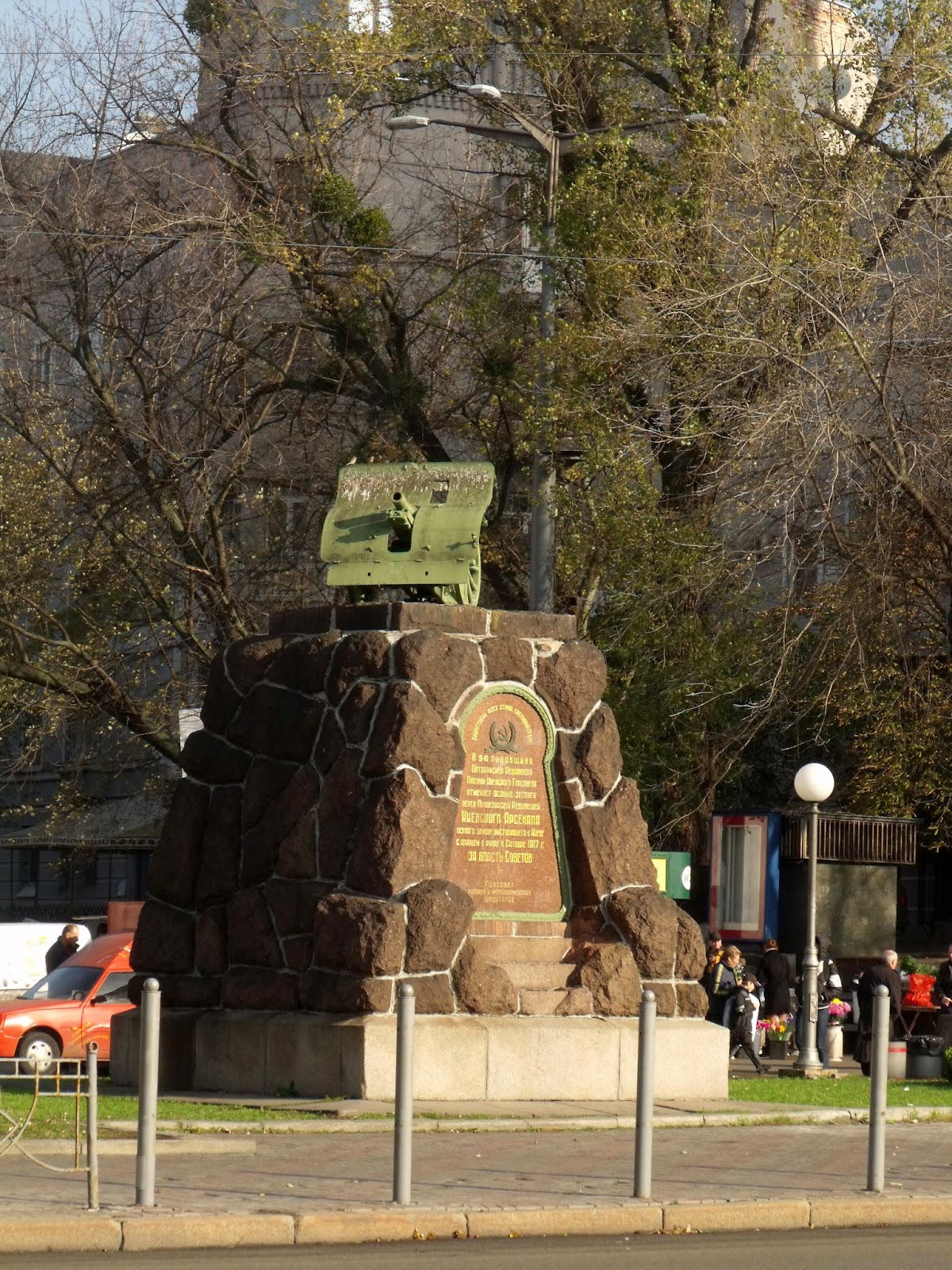 |
| January Uprising monument near the Arsenal train state in Kiev. |
The current state-nationalist propaganda sculpts national heroes out of the sons of noblemen, merchants and rich farmers, but in every way throws mud on the memory of the opposing youth from the working class districts of Kiev. Just like 97 years ago, by “national interests” our bourgeoisie means not the interests of the majority of workers, but the selfish interests of a handful of capitalists and the “national-conscious” intelligentsia that serve them.
And if today, instead of honoring the heroes of Arsenal, you worship mythological images of the “Kruty heroes,” then you are at the same time with them — and against the working class.
Translation by Greg Butterfield

 Red Star News + Translations