By Greg Butterfield
Based on a talk at the Workers World Party Forum in New York on January 23, 2015.
The rush-hour shelling of a trolley bus in the capital of Donetsk left 13 dead and 20 wounded January 22. At least 100 civilians were killed January 21 alone in the Ukrainian terror-bombing of cities in the Donetsk and Lugansk People’s Republics of the Donbass mining region, also known as Novorossiya.
Since the Kiev junta announced the resumption of hostilities January 18, Gorlovka has been shelled non-stop, and cluster bombs were dropped in the Lugansk city of Stakhanov.
The United Nations reported January 22 that the official death toll of Kiev’s “Anti-Terrorist Operation” is now 5,086 – although the UN admits this is seriously undercounted. Of these, 262 deaths occurred in the last nine days.
As horrible as this is, it’s important to know that the Novorossiyan people’s militias are fighting back strongly. Once Kiev cast aside the last pretense of a ceasefire, the militias took the long-contested Donetsk airport, moved to the outskirts of occupied Mariupol, and now are taking the fight to Ukrainian forces all along the front lines.
Donetsk Prime Minister Alexander Zakharchenko has declared their intention to expand the people’s republics’ control to the full territory of Donetsk and Lugansk, beyond the rump area they were restricted to under the Minsk Accords last September.
Zakharchenko, a former militia leader, in recent days has proven a masterful propagandist, appealing to the families of Ukrainian soldiers with a message urging them to resist the new wave of the highly unpopular military draft – the fourth in Ukraine in less than a year.
Novorossiyan forces reportedly lost 300-350 killed and wounded soldiers in the past week. The junta lost 1,200 killed, wounded, prisoners of war and missing in the vicinity of Donetsk airport alone.
January 24 will be a day of remembrance in Donetsk for the victims of the trolley bus bombing and other victims of the junta. But don’t expect to see world leaders flocking to Donetsk the way they did to stand with imperialist France and Charlie Hebdo a couple of weeks ago.
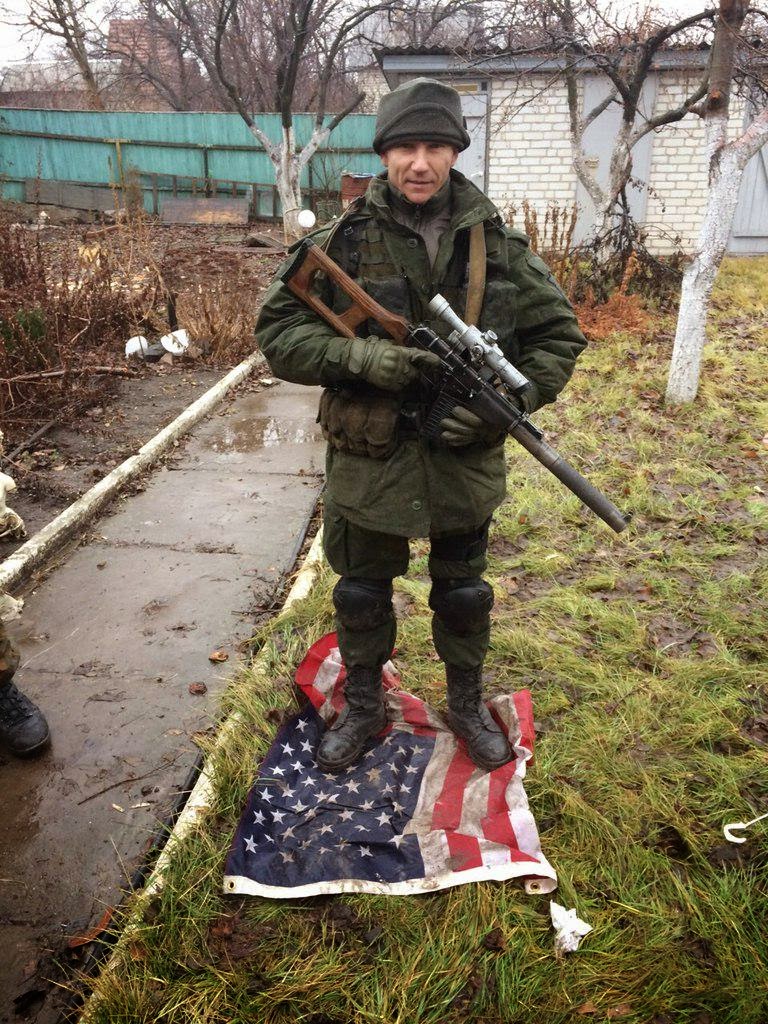 |
| Novorossiyan militia member shares his opinion of U.S. imperialism. Source: Colonel Cassad |
Pentagon to train Nazi troops
In fact, the same day the trolley bus passengers were massacred in Donetsk, Lt. Gen. Ben Hodges, head of the U.S. Army in Europe, was in Kiev. There he met with wounded Ukrainian soldiers and thanked them for their service.
More importantly, he also met with the commander of the Ukrainian armed forces and the head of the fascist National Guard, which reports to far-right Interior Minister Arseny Avakov. Hodges announced that U.S. troops will soon deploy to Ukraine to train National Guard troops.
To mark the lieutenant general’s visit, the U.S. Embassy gave the first prototype of a new armored vehicle, the Kozak, to Ukraine’s Border Guard.
Ukrainian attacks on Donbass have been escalating steadily since the New Year. But we can trace this development back further, to December 4.
Many people will remember that as the night of the first big demonstrations after a grand jury decision exonerated the NYPD cop who choked Eric Garner to death. Here in New York we packed Foley Square and then marched over the Brooklyn Bridge.
What was the House of Representatives doing that night? Were they discussing measures to curb police terror against Black and Brown communities?
No. Instead the House passed a resolution condemning Russia and supporting the far-right junta in Ukraine. Former Congressman Denis Kucinich called it a “declaration of war.”
It passed by 411-10, and the ten dissenters were evenly split between Democrats and Republicans, showing the truly bipartisan imperialist unity on this issue.
If that was the declaration, then what came a week later was the means to make war. On December 11, both the Senate and House passed the so-called Ukraine Freedom Support Act, providing millions of dollars in additional military aid to Kiev, opening the door to directly arming the junta, and providing for additional sanctions against Russia.
Even before President Obama signed it into law on December 18, airports in southeastern Ukraine had shut down to received planeloads of U.S. weapons, vehicles and ammunition. President Peter Poroshenko then toured the country, lavishing new weaponry on military units.
Other preparations followed in quick succession. Ukraine’s parliament revoked the country’s non-aligned status and officially declared its intention to seek NATO membership. A NATO mission opened in Kiev January 1.
In mid-January, U.S. financier and anti-communist George Soros flew to Kiev to help cook up a refinancing deal with the IMF to save Ukraine from defaulting on its debt.
Why now?
We know the U.S. has been the driving force behind the coup last February and everything that has been unleashed on the people of Donbass and Ukraine since then. But why is Washington pushing even harder now? What’s changed?
What’s changed is the economic crisis in Russia brought about by the collapse of the global oil market. U.S. and European sanctions that could be laughed off or circumvented six months ago now have real bite.
There’s never been unanimity among Russia’s capitalist ruling class about Donbass. There are also many Russian oligarchswho want to return to the neoliberal relationship with the U.S. that existed in the 1990s under Boris Yeltsin. These forces could be kept in check when there was relative prosperity. Now they are raising their heads more forcefully, demanding the abandonment of Donbass and an end to what they view as a costly global confrontation with the West.
All the capitalist factions understand that the long term U.S. goal is to dominate and break up the Russian Federation. And all are united in regarding a revolutionary, socialist development in Donbass as even more dangerous to their interests. This is why they try to control and tamp down the struggle there, even though a strong revolutionary Novorossiya would actually be the best guarantee of Russia’s sovereignty.
During the Gorbachev period before the collapse of the Soviet Union, Workers World Party chairperson Sam Marcy was fond of using the term “full-court press.” By this he meant the U.S. was using all means of pressure – financial, military, propaganda, cultural, etc. – to exacerbate the internal contradictions in the USSR and bring about its destruction.
Today Washington is employing a similar strategy aimed a Russia. Along with the NATO buildup in Eastern Europe and more direct U.S. military intervention in Ukraine, the Ukraine Freedom Support Act includes millions of dollars earmarked to increase the influence of U.S.-backed NGOs and political opposition loyal to imperialism, as well as to increase Russian-language propaganda broadcasts.
This development has big ramifications for Syria, Iran, China, Venezuela, the BRICS alliance and many other countries. But Donetsk and Lugansk are literally the front line.
Workers World Party, the International Action Center and the United National Antiwar Coalition have done much to raise this important struggle in the U.S. We have disseminated information, held protests and teach-ins, brought the issue to diverse actions like LGBTQ Pride and rallies for Gaza, and developed relationships with comrades and allies on the front lines.
But the fact remains that more of the working class is unaware of what is happening in Ukraine and Donbass, or of the U.S. role. Most of the left is at best silent, at worst active cheerleaders for the agents of U.S. imperialism, as in Syria.
This struggle is not going away and could escalate into the dominant world issue. Now is the time to raise solidarity with Novorossiya and the antifascist resistance in Ukraine, and push it out into the broader movement, finding ways to link the struggle against war and fascism in Ukraine with the new, dynamic movement against police killings and the racist capitalist system.

 Red Star News + Translations