By Andriy Bondarenko
January 17, 2015 – Analyzing the facts leading up to the arrest of our comrades Sergei Tkachenko and Denis Timofeev, I come to the conclusion that this process was inevitable. Not because they are “hardened criminals” who broke the law, but because the Dneprodzerzhinsk city organization of the Communist Party of Ukraine has long been in conflict with the powerful in the hometown of Leonid Brezhnev.
The roots of the conflict were laid before both protagonists even thought about politics. In the ‘90s, the “city of fiery dawns” gave strong results to the Communist Party in elections, and, most worryingly for the local elites, time after time sent to the parliament a representative of the Communist constituencies: first Anton Koropenko, then Vyacheslav Anisimov. This steady “red” result dominated the attention of the party’s foes. They deliberately stabbed it to pieces, fueling internal conflicts. So much so that the city once had three “official” Communist Party organizations at the same time (each with registration documents and a seal to prove that it was the “official” Communist Party in Dneprodzerzhinsk), each conducting separate rallies and demonstrations. The party’s authority in the city rapidly eroded. It was in this state that young Sergei Tkachenko found the Communist Party organization when he moved to Dneprodzerzhinsk in 2006.
Coming from a simple rural family, he graduated from the Novomoskovsk, Dnepropetrovsk, agrarian technical college, worked in the village of Dmuhalovka in the Mahdalynivka region, and later became engineer on a farm in the village Novoukrainka, adjacent to Dneprodzerzhinsk, owned by the currently beleaguered businessman Oleg Tsarev, who was then in the Party of Regions. Sergei rose from the bottom, from an ordinary member to leader of the regional Komsomol organization. Then he joined the Communist Party and became secretary of the Magdalinovsk District Committee. On the electoral lists of the Communist Party of Ukraine, Sergei was elected a deputy of the Dnepropetrovsk Regional Council.
A seemingly meteoric career — but, despite the fact that the Communists and the Party of Regions were then in a coalition on the Regional Council, jointly opposed to the “orange” government, Sergei showed integrity and did not turn a blind eye to the ruthless exploitation of farm workers, initiating the creation of a trade union. Conflict broke out immediately, and the Regionals “allies” instantly demanded his dismissal. So Sergei Tkachenko became a professional party worker. After his dismissal, he was sent to the Higher Party School, after which he was elected First Secretary of the Bagleyskiy District Committee, then Secretary of the Municipal Committee, and a little later first secretary of the Dneprodzerzhinsk City Committee.
In fact, thanks to the persistent work of Sergei Tkachenko, the Communists managed to eliminate fragmentation, rallying the members by redirecting their energy from small parties into constructive activity: the study of Marxism and fight for the interests of workers, systematic agitation at factory gates, film clubs, production of leaflets, newspapers, etc. The impact was rapid and the authority of the Communists rose sharply. In 2010, Sergei was elected a deputy of the Dneprodzerzhinsk City Council.
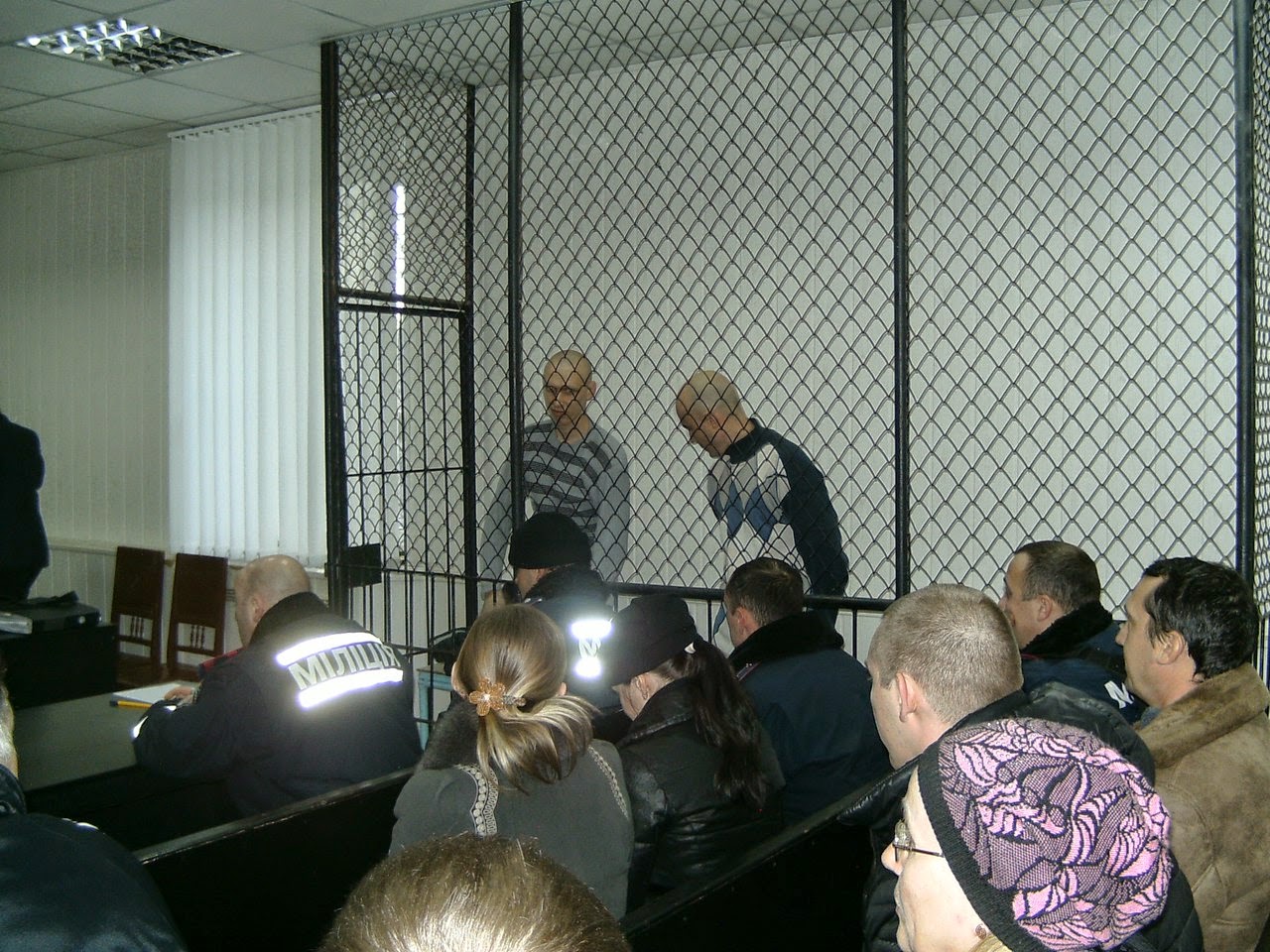 |
| Dneprodzerzhinsk political prisoners in court. |
Denis Timofeev comes from the workers. He graduated from vocational school, and worked in many plants: “Bagleykoks,” MQM, Dzerzhinsky, “Dneprovagonmash,” service stations and other companies. For the last six months before his arrest, he worked as a taxi driver using his personal car, bought on credit. In a word, a worker who through his class instinct found his way into the Communist Party of Ukraine. He engaged in party activities in his spare time, having risen from a rank-and-file communist to first secretary of the Bagleyskiy District Committee of the Communist Party. And even when he no longer had enough time for that role, and could not obtain credit on account of having the “wrong” party affiliation, he did not run away from his post and became second secretary of the District Committee.
When the ultra-right in Dneprodzerzhinsk began to raise its head, Denis, as a man of strong anti-fascist views, initiated the establishment of the citywide public organization Anti-Fascist, which repeatedly held rallies and marches to explain the true nature of the Ukrainian ultra-nationalists — as satellites of the bourgeoisie. During one of these rallies on August 24, 2013, a fight broke out between the communists and Svoboda. Denis was one of the victims — he broke his leg. Another notable event of the Anti-Fascist group was an anti-capitalist march on February 5, 2014, which was led by Timofeev.
When the Party of Regions “merged” with those in power, and visiting Maidanists began to roam the city, threatening to destroy the local monument of Lenin, Sergei and Denis did not hide in the bushes. They came out to defend the statue of Lenin, and organized weekly meetings in defense of the monument of Dzerzhinsky, where 24-hour guard duty sometimes ended with a busted heads for the defenders. A month later, the confrontation petered out, and the communists decided to switch to educational propaganda work among the population. In April and May, thousands of leaflets and newspapers were distributed warnings about social genocide, how the capitalist regime was preparing to unleash carnage in which ordinary working people would die. Gradually the agitation began to bear fruit, and if earlier, communists were accused of rushing like a bull to red, by summer the reaction of the residents began to change for the better. But with the growth of sentiment opposing the current authorities, state terror against the communists intensified: from “questioning” by the Security Service of Ukraine (SBU) to attacks by right-wing militants on the offices of local party committees.
It was during this period that the communists created a newsletter called “Prometheus” – the legendary hero is a symbol of Dneprodzerzhinsk, depicted in the local coat of arms, and the city has a monument to him. Only three issues were published, but they got a great response. Maidan supporters repeatedly issued death threats, forcing the communists to resort to various tricks when distributing the newsletter in order to exercise their constitutional right to express their views and not be beaten by militants. But the main “crime” was that Prometheus was distributed mainly in the workplace, in close proximity to the factories — in particular, at the gates of the metallurgical plant. Union leaders in the pocket of the far-right tried to crack down on the communists as they did in the days of Yanukovych, but they were unsuccessful. I do not know how, but “Prometheus” came to the attention of the SBU. While it contained nothing “separatist,” as proven on subsequent examination, criminal proceedings were instituted, and Judge Babushkinsky Litvinenko of the district court of Dnipropetrovsk, authorized an SBU request for searches of a number Communist Party activists.
Searches of the first and second secretaries of the City Committee of the Communist Party, Sergei Tkachenko and Elena Suchkova, second secretary of the Bagleyskiy District Committee Denis Timofeev, as well as the premises of the City Committee and the Dnieper District Committee, were issued on September 1. Thus the authorities planned to neutralize the local party leadership, believing that after this the rank and file would scatter.
It was a wasted effort to search for anything illegal in the party offices. Nevertheless, searches were conducted in the absence of the leadership of the city party organization, in violation of the rules of criminal law procedure. Nor was there anything to be found in the “raids” on the homes of Dneprodzerzhinsk communist leaders, but here the SBU agents decided to err on the side of caution and planted evidence of “separatist” sympathies during the searches.
The script was standard. In each case the search took place in two stages, and, unfortunately, was not documented on video. During the search in a cramped apartment it was hard to keep track of the actions of all the participants and what they were up to. When nothing but the bulletin “Prometheus” was found and everyone relaxed, “suddenly” dozens of copies of the newspaper “Novorossiya” turned up in the hallway. The search was resumed and eventually brought the desired result. Tkachenko and Timofeev were found to have grenades and TNT, in places that had already been examined. Sergei — in the kitchen bin (where, by a strange coincidence, the investigator began to write the report, ostensibly to speed up the process, and for a while was out of sight of all witnesses and suspects). Denis — in the summer kitchen, used as a junk closet, covered in a centimeter layer of dust, but in this case the grenade was neat and lay in plain view – how did they “not notice” during the initial search? Elena Suchkova was the most fortunate; only the newspaper “Novorossiya” was planted in her apartment. Since her husband Roman was not at home, apparently the investigators did not want to be bothered with the children, who would be left alone in case of Elena’s arrest. Speaking of children: Sergei Tkachenko has three (6-year-old daughter Tatiana, 3-year-old son Ivan, and baby Daniel, 1 year), Denis Timofeev has two (daughter Daria, 9 years old, and son Daniel, 5 years). Their wives are left in a difficult situation now, but they understand, as they are also communists.
Immediately after the arrest, our comrades faced procedural violations by the security services and the judiciary. Despite the positive reports of their workplaces, their parliamentary activities and having families with young children, the same District Court judge Babushkinsky Litvinenko chose to detain them pending trial. The fact that there was no risk of destruction of evidence (which was removed) or interference with witnesses (information which they did not know) was not taken into account. An appeal went nowhere. Although the judges could barely contain their laughter at the unsubstantiated arguments of the investigators and prosecutors, the order of detention was not changed. And during the picketing of the court session, the protest was attacked by the right-wing.
Complaints lodged by defense lawyers against the investigators, demanding a criminal case for falsification of evidence, failed and brought only bureaucratic replies. An appeal to the European Court of Justice also brought nothing. But, using the fact that the 48th Congress of the Communist Party of Ukraine had nominated Tkachenko and Timofeev as parliamentary candidates for constituencies № 30 and № 40, lawyers Maxim Kudryavtsev and Alexander Pasternak won a re-trial on the preventive detention measure. Denis managed to be placed under house arrest.
And here’s the end result. The case was transferred to the District Court of Dneprodzerzhinsk, where the trial began on December 9. At the preparatory meeting, the prosecution insisted on the guilt of Tkachenko and Timofeev in committing crimes under Part 2 of Art. 110 (“Intentional acts committed in order to change the borders of the state of Ukraine or in violation of the order established by the Constitution of Ukraine, as well as public calls or redistribution of calls for such acts … on preliminary arrangement by a group of persons …”) and Part 1 of Art. 263 (“Carrying, possession, purchase, manufacture, repair, transfer or sale of firearms (except for smooth-bore hunting), ammunition, explosives or explosive devices, without lawful authority”) of the Criminal Code of Ukraine. The prosecution team includes the regional public prosecutor, State Customs Service and State Border Guard Service of Ukraine, and Dnepropetrovsk regional prosecutor Ivan Turbaba. Judge Tatyana Ivchenko is hearing the case. The defendants pleaded not guilty, insisting that the items seized during the search did not belong to them.
Despite the fact that Denis Timofeev did not flee during his two months of house arrest, the judge granted the prosecutor’s request to change his measure of restraint to detention at the December 22 hearing.
On January 13, the hearing was to begin consideration of the facts of the case. Four local film crews and national media expressed a desire to cover the trial. But the court did not allow video and photography, referring to possible public pressure on witnesses — despite the fact that it is resonant with the public interest.
“Perhaps there is something to hide from the media. We wanted to show the TV channels that were filming that we have nothing to hide, we have an open position,” commented defense lawyer Alexander Pasternak.
“I do not like the fact that the court refused to allow the media to cover the process. We believe that in this case there is nothing to hide, the public should be aware of what is going on in court. Having survived the political turmoil in our country, we are entitled to it. But I have to admit that the situation in the judicial system has not changed. It begins with the falsification of evidence and ends up in court, with no transparency,” said defense lawyer Maxim Kudryavtsev.
During the hearing there was examination of witnesses. The meeting broke up during the examination of the second witness, before the defense had time to ask questions.
The next meeting is scheduled for January 27.
Editorial LIVA encourages our readers to render all possible assistance to the Dneprodzerzhinsk political prisoners, transferring funds through bank Privat:
4149 4378 4996 9249
a / c 29244825509100
MFO 305299
EDRPOU 14360570
Recipient: Tkachenko Elena (wife S.I. Tkachenko): m. 097-684-76-52
a / c 29244825509100
MFO 305299
EDRPOU 14360570
Recipient: Tkachenko Elena (wife S.I. Tkachenko): m. 097-684-76-52
They do not count on anyone for solidarity but their comrades.
Translation by Greg Butterfield

 Red Star News + Translations