By Nahia Sanzo
Jan. 21, 2015 – After years in which some wanted to see in the dissolution of the Soviet Union the end of history, the complete victory of a world shaped in the image of the United States, the unique and indisputable leader of this era, the Ukrainian crisis has brought back, against all odds, the figure of Lenin. At a time when the struggle between two irreconcilable visions of Ukraine has exploded in a coup and civil war, monuments of the first Soviet leader have become a symbol of the struggle between those who see the Soviet legacy as part of their identity and those who want to eliminate any reference to that stage of the country’s history. These monuments, still common in many of the republics of the former Soviet Union, have become a weapon of war.
Once protected by the Berkut and the Communist Party of Ukraine, two of the victims of the revolution of Maidan, the last statue of Lenin in Kiev has already disappeared from the urban landscape of a city that would have to remove too many buildings to deny its Russian past. The demolition of the statue became one of the first symbols of the Maidan revolution, which months later would lead to the overthrow of President Yanukovych and the imminent outbreak of protests in the East, discontented by the coup d’état that had overthrown the president chosen at the polls and whose first measures indicated a nationalist agenda that would give little account to the interests and rights of the Russian-speaking population, as native as the Ukrainian-speaking population, whose identity and history are still threatened today.
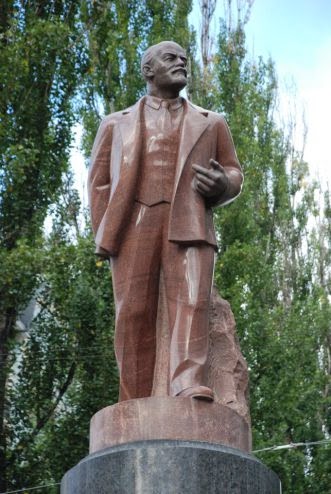
In those first moments of the new regime, before the prime minister called Russian-speaking citizens subhuman, before he spoke of the Russian invasion of Ukraine and Germany during World War II or threatened to designate the Soviet Union as an occupying force in the history books, protesters defended monuments to Lenin in Kharkov and Donetsk with their bodies.
Approaching the first anniversary of the coming to power of the new authorities, more than 150 monuments recalling Russian or Soviet heritage have fallen in Ukraine, Russian films have been censored for their alleged anti-Ukrainian content, Russian or Russian-speaking media have been closed or attacked, while those who fight against the Ukrainian army that continues bombarding cities still outside their control have been declared terrorists.
Only part of the rebellion in Donbass fights under the red flag. Different interests and different banners mix in both the military and political representatives of the People’s Republics of Donetsk and Lugansk, Russian, Soviet or even imperial; but against the Ukrainian insistence on destroying the entire Soviet legacy, the Russian-speaking population in Donbass defends the Soviet heritage, not only as a time of industrialization and growth, but as part of their identity.
Months ago the monument to Lenin in Kharkov, which several years ago was digitally removed from a promotional video for Euro 2012, fell at the hands of right-wing groups, with the blessing of the minister of the interior and at the cost of the health of a man who dared to defend the monument. In those days, some citizens laid flowers at the base of the monument, making it clear that the unanimity which the government claims for removing Soviet symbols does not exist. Days later, the demand was clearer and more in line with the times: “I live. I have joined the militia. I will be back soon,” said graffiti on the base of the toppled statue.
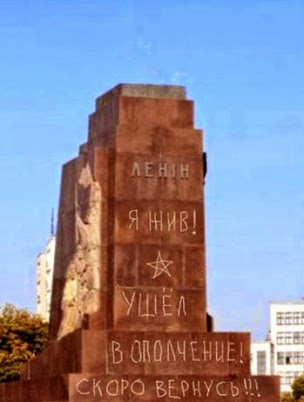
In their eagerness to destroy the past before building a future for the country, monuments to Lenin are still an obsession of the extreme right, as the Soviet heritage is for the government. The statues are demolished in cities seized by the Ukrainian army as acts of celebration of Ukrainian culture and identity, regardless of the opinion of the local population.
In a time of crisis and destruction, in which there seems to be no project for the future, some Soviet symbols have become, not only in eastern Ukraine but also in many depressed areas of the former Soviet Union, symbols of the opposite. Therefore, beyond ideology, even in the Donbass areas controlled by the Ukrainian army, some residents continue to defend the monuments to Lenin, continue to gather in the squares, for example, in Slavyansk, so punished by Ukrainian bombings last summer and under government control since July 4.
The new government of Ukraine, obsessed with blotting out the Soviet legacy and eliminating any positive reference to that part of history, has already decided to implement a centralized state model in which Ukrainian culture replaces all Russian heritage, forgetting that the country was born of the union of Ukrainian provinces and Russian provinces, which were later joined by Crimea. But above all, the new Ukraine wants to forget that it was Lenin who ceded the industrialized eastern lands that have given so much wealth to the country in the years since independence.
That gesture of Lenin represents, on the one hand, the importance of Ukraine to Moscow, which could not afford then to lose the breadbasket of the Soviet Union, and which cannot afford today to lose a country of 40 million inhabitants, which has been, until now, one of its major trading partners. Whatever happens in Donbass, although Russia works quickly to replace imports of Ukrainian industrial products, the Ukrainian choice of opting for the European Union instead of the Eurasian Union is clear. It remains to be seen whether it is also a defeat for Ukraine.
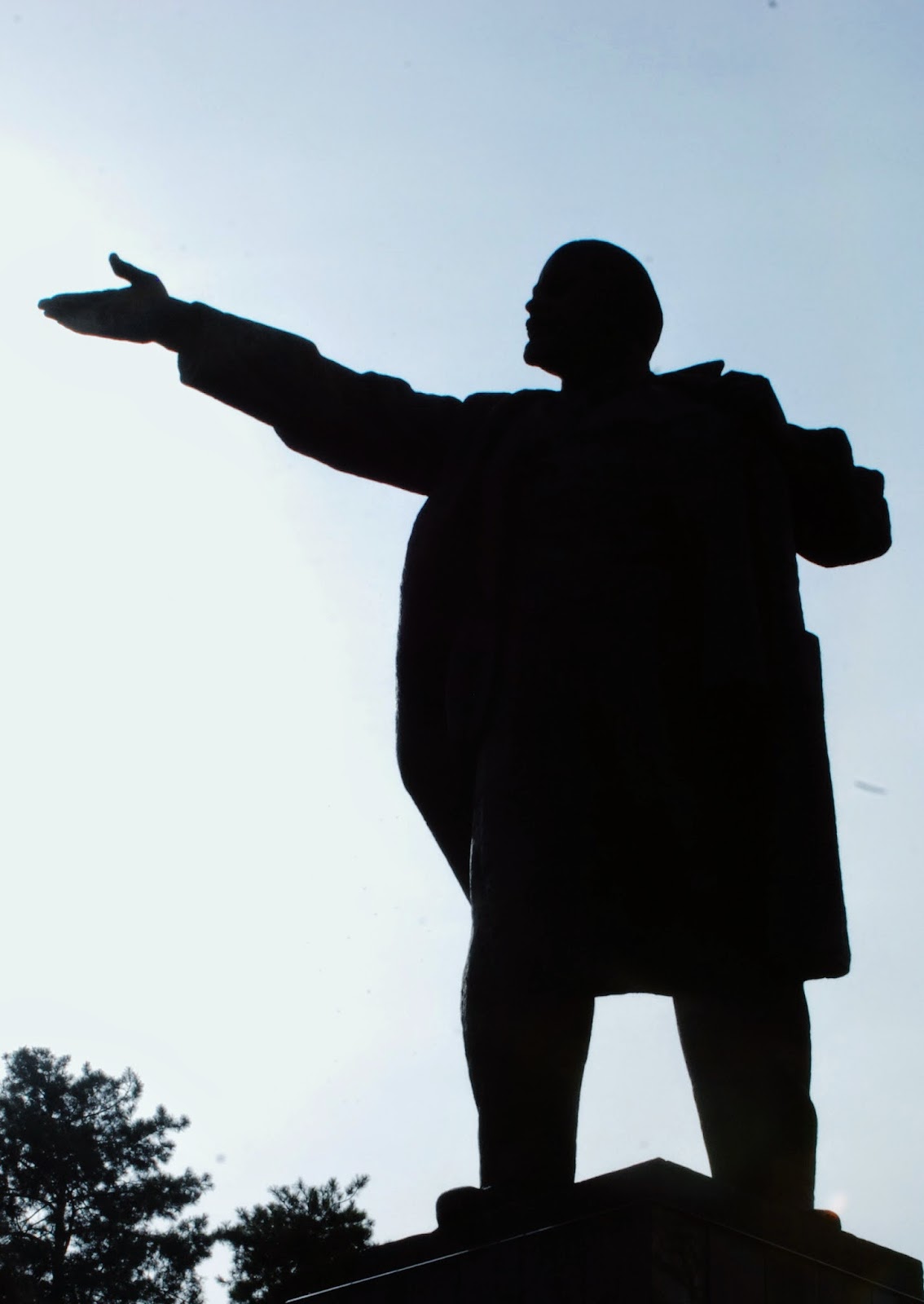
Lenin’s gesture also represents a compromise that today’s Ukraine, which cannot afford to lose another part of the country, is unwilling to accept. To its nationalist agenda and the imposition of only Ukrainian culture in the country, any reference to the Soviet past, which is actually a reference to the Ukrainian history of the twentieth century, is a hindrance to the construction of the country’s new identity. Because the war waged by Ukraine in the East is not against Russia, against the Soviet past or against itself, but a war in which one model of Ukraine tries to destroy, by military force or threats, the identity of others. With destruction as its method, all Soviet elements, the very memory of a country that, for all its mistakes and contradictions, sought to create and grow, is a hindrance. At 91 years after his death, every image of Lenin is an uncomfortable reminder that the Ukrainian culture and language the new government tries to create, separate and apart from Moscow, is not the result of history, but a distortion of it.
Translation by Greg Butterfield

 Red Star News + Translations
I guess this place should be subjected for historic preservation. I believe that even though they do not like what happened in the past, they cannot change it by removing statues like that one. It's already part of the history, and removing them might only raise issues that can lead to a bigger problem. Daniel Roberson @ Mark Bentley PA
LikeLike